
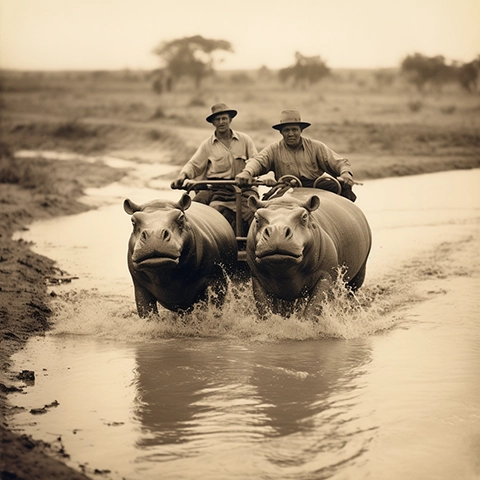
At the turn of the 20th century, the United States faced a peculiar conundrum: a cranberry shortage. The demand for this vibrant, tart fruit had grown exponentially, and the existing cranberry bogs couldn’t keep up with the nation’s appetite. Enter Frederick Burnham and Elwood Mead, two men with an extraordinary vision to resolve this crisis: they decided to enlist the help of hippos.
Frederick Burnham, an adventurer and former British scout, was well-known for his exploits in Africa and his familiarity with hippos. Elwood Mead, on the other hand, was a distinguished agricultural scientist who believed that these massive creatures could be domesticated and utilized to cultivate cranberries. Thus, they embarked on a journey that was as audacious as it was bizarre.
In 1910, Burnham and Mead imported a small herd of hippos from Africa to the United States and established their farming venture in Louisiana, an environment they believed was suitable for these semi-aquatic creatures. They set up a cranberry farm with raised pools and carefully planned walkways for the hippos. The idea was for the hippos to roam freely, harvesting cranberries while fertilizing the bog with their dung—a perfectly sustainable, if somewhat unconventional, farming concept.
However, the reality proved far more challenging than they had anticipated. Hippos, known for their territorial and aggressive nature, didn’t take kindly to their new roles as cranberry farmers. The hippos wreaked havoc on the farm, trampling through the bogs and consuming vast quantities of cranberries. The experiment was turning into an expensive and destructive folly.
The final, and most tragic, chapter of this peculiar saga involved a fateful encounter between one of the hippos and Frederick Burnham. In a moment of sheer misfortune, Burnham found himself between the massive jaws of one of the hippos. The creature’s powerful bite proved fatal, marking the first and only recorded hippo-related fatality in the United States. Burnham’s death was a grim reminder of the perilous nature of attempting to domesticate these formidable creatures.
Elwood Mead, who narrowly escaped the attack, was left to pick up the pieces of their grand experiment. Realizing the impossibility of their cranberry farming venture, Mead made the practical decision to sell the surviving hippos to the zoo. The hippos found a new home, far removed from the cranberry bogs of Louisiana.
The great hippo farming experiment of the early 1900s was an eccentric endeavor that ultimately failed to alleviate the cranberry shortage, but it left an enduring mark on American folklore. While the audacity of the idea and the tragic outcome are remembered today as a cautionary tale, it serves as a testament to the adventurous spirit of pioneers who were willing to push the boundaries of convention and explore the uncharted territories of possibility in the pursuit of progress.